Definition
Enterprise AI
What enterprise AI is, what a real enterprise AI platform must include, and how regulated organisations deploy it without giving up control of their data.
By James Drayson
In short
Enterprise AI is artificial intelligence deployed at organisational scale, embedded in real workflows, governed centrally, and held to enterprise standards for security, compliance, and auditability. Unlike a chatbot demo or a per-seat productivity tool, enterprise AI must integrate with identity, data, and existing systems, and for regulated buyers it increasingly means owning the model rather than renting an API.

What counts as enterprise AI?
Most coverage of "enterprise AI" blurs three different things: a consumer chatbot used at work, a per-seat copilot bolted onto an office suite, and a genuine enterprise platform. Only the third meets the bar regulated organisations actually need.
Enterprise AI, properly defined, satisfies four tests: it operates at organisational scale rather than per-user; it integrates with identity, data and existing systems of record; it is governed centrally with auditability and access controls; and it meets the security, residency and compliance standards procurement actually requires (ISO 27001, GDPR, sector regulators, increasingly the EU AI Act).
What a real enterprise AI platform must include
- A model you can own: Either a model you hold the weights to or, at minimum, a clearly bounded model not subject to silent vendor changes.
- Controlled data path: Inference inside your perimeter (on-prem, private cloud, or sovereign cloud), with no third-party training reuse.
- Identity and access: SSO, RBAC, and per-team or per-document permissions, so the AI inherits your existing controls.
- Retrieval over your data: RAG or post-training on your documents, so answers are grounded in the organisation's truth rather than the public internet.
- Observability and audit: Logging of prompts, retrievals, and outputs, with retention you control, to satisfy regulators and internal risk.
- Lifecycle ownership: You decide when the model updates. No silent vendor swap mid-quarter.
Per-seat copilots vs an enterprise AI platform
Per-seat copilots (Microsoft 365 Copilot, Google's Gemini for Workspace, etc.) ship general-purpose AI inside productivity suites. They are useful for individual tasks and easy to roll out, but they are not an enterprise AI platform: the model is the vendor's, the data path runs to the vendor, and the capability is general rather than tuned to your domain.
A platform-level enterprise AI is different. It is one capability the whole organisation builds on, sized to your workloads, integrated with your data, and accountable to your governance, not 50,000 individual licences calling someone else's model.
Why regulated enterprises are choosing owned models
Three forces are converging. First, the EU AI Act is now in force and creates documentation, transparency, and oversight obligations that are dramatically easier to meet when you control the model and the data. Second, the US CLOUD Act means data held by US-owned cloud providers can be compelled even when it sits in a UK or EU region, residency alone is not jurisdiction. Third, the per-token economics of cloud APIs make sustained enterprise usage open-ended and unpredictable.
Together, these turn "own vs rent" from a philosophical question into a procurement one. For the AI that touches your most sensitive data and your core workflows, ownership is becoming the default in regulated sectors.
How to deploy enterprise AI safely
- Start with the data path: Map every place sensitive data would flow before picking a model. If it leaves your perimeter, treat that as a deliberate decision, not an oversight.
- Separate use cases by sensitivity: General productivity can live on a hosted API; regulated, confidential, or core workflows belong on an owned, in-perimeter model.
- Pick a model you can document: If you cannot describe what the model learned and how it behaves, you cannot meet AI Act or sector obligations.
- Plan for retraining, not one-shot deployment: Enterprise AI compounds in value when the model is retrained on your data on a schedule you set.
- Procurement first, pilot second: ISO 27001, DPA, residency, and audit need to be agreed before, not after, the pilot.
How Locai delivers enterprise AI
Locai Labs builds owned, domain-trained models for regulated enterprises. We post-train a strong open base on your data using the Forget-Me-Not framework, then deploy it inside your perimeter via Locai One (on-prem), your private cloud tenant, or a UK sovereign cloud. You receive the weights, the application layer (chat, API, document workflows), and a retraining cadence so the model compounds in value. The principle behind the work is simple: a smaller expert model built on your data routinely outperforms a much larger generalist on the work that actually matters to your business, and you own it.
Enterprise AI platform vs per-seat copilot vs cloud API
| Enterprise AI platform (Locai) | Per-seat copilot | Cloud API | |
|---|---|---|---|
| Unit of deployment | Organisation-wide capability | Per-user licence | Per-token access |
| Model ownership | You hold the weights | Vendor's | Vendor's |
| Data path | Stays in your perimeter | Sent to vendor | Sent to vendor |
| Trained on your data | Yes (post-trained) | RAG only, no training | No |
| Identity & RBAC | Native, document-level | SSO via suite | DIY |
| AI Act documentation | Direct, you hold the artefacts | Vendor-dependent | Vendor-dependent |
| Cost model | Fixed, owned asset | Per-seat, recurring | Per-token, recurring |
What an enterprise AI platform buys you
One capability, organisation-wide
Not 50,000 separate copilots, one platform tuned to your domain and governed centrally.
Compliance becomes documentable
Owning weights, data, and logs turns AI Act and GDPR obligations from black-box risk into evidence.
Predictable, not open-ended cost
A fixed-cost asset instead of a per-token bill that grows with every user and every quarter.
Domain accuracy
A model post-trained on your data routinely beats much larger general models on the tasks that matter.
What this looks like with Locai
If the architecture above is the bar your enterprise has to clear, here is the shortest route to clearing it.
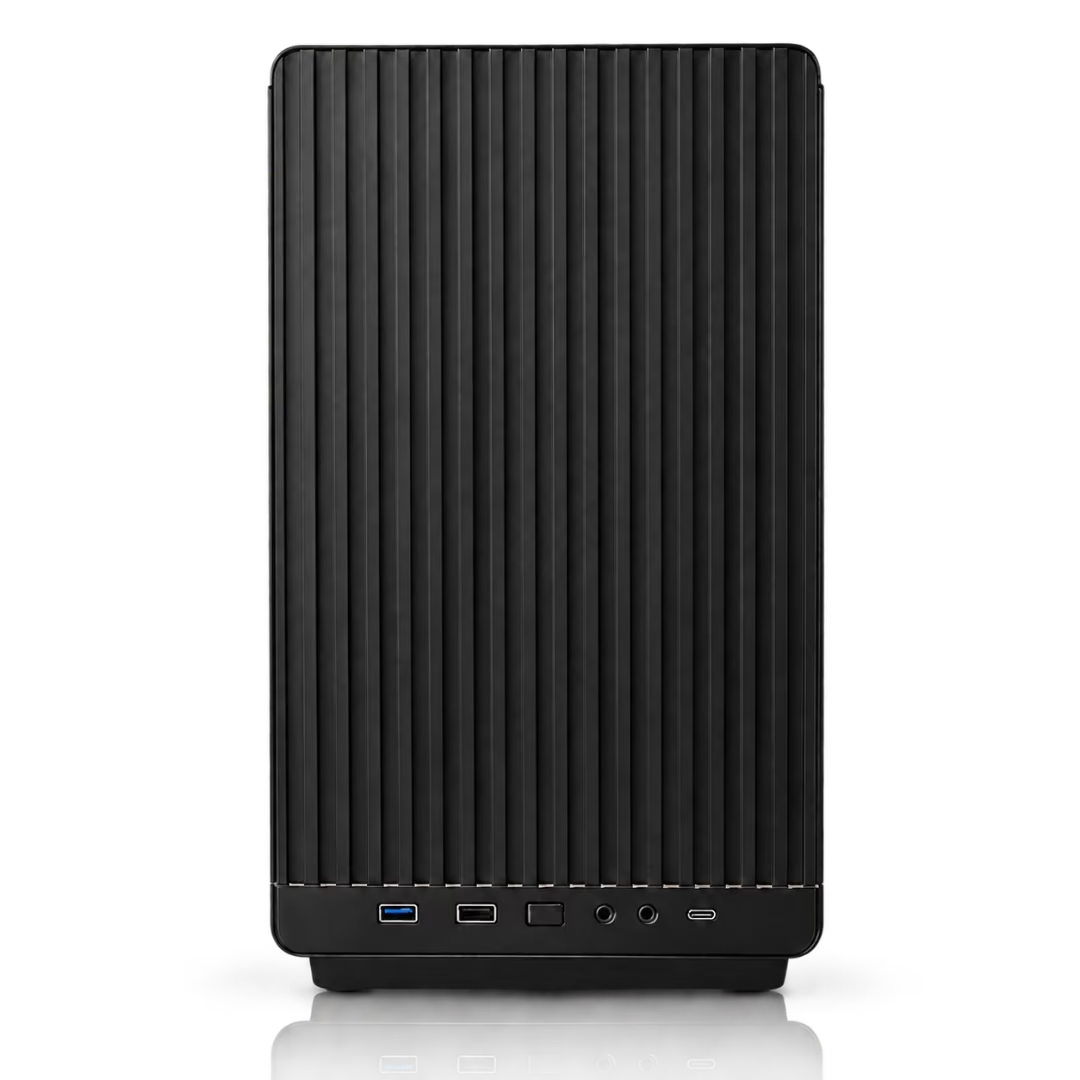
Locai Labs builds Locai One, an on-prem AI appliance. It is one machine that arrives with everything already in it: the hardware, our open-weight Locai Juno models, and Locai OS, the operating system that serves the models and handles users, access and monitoring. You plug it into a mains socket and your network, and your team is working in about 15 minutes. No cloud account, no per-token bill, and nothing leaving the building.
The reason a data-centre-class model fits in a box on your floor is SPACE, our compression algorithm. Instead of asking how much of a model can be cut while keeping it broadly similar, SPACE asks what the model needs to be good at, preserves the subnetworks behind those capabilities and strips back the rest. The result is a smaller specialist rather than a shrunken generalist, tuned to the exact hardware it ships on.
Locai One starts at £29,950 for a team, and Locai One Pro at £49,950 for an organisation, bought once and owned outright. Both run air-cooled on standard mains power and work fully air-gapped. Any compatible open-weight model runs alongside Juno, and if you need a model trained on your own proprietary data we can post-train one and deploy it on the same machine.
Frequently asked questions
What is enterprise AI?
AI deployed at organisational scale, governed centrally and integrated with identity, data, and existing systems, held to enterprise standards for security, compliance, and auditability.
What is an enterprise AI platform?
A single, organisation-wide AI capability with a model, data integration, identity, observability, and lifecycle management, rather than a per-seat copilot or a raw API.
Is Microsoft 365 Copilot enterprise AI?
It is enterprise-grade productivity AI, but it is not an enterprise AI platform: the model is Microsoft's, the data path runs to Microsoft, and the model is not trained on your domain. For regulated workloads, an owned platform is usually required alongside.
How is enterprise AI different from generative AI?
Generative AI is the underlying capability. Enterprise AI is how an organisation deploys it safely, at scale, with governance, integration, and ownership of the data and (ideally) the model.
How do enterprises actually use AI today?
Document understanding, research and analyst workflows, customer and employee support, regulated content drafting, internal knowledge, and increasingly agentic workflows that take action across systems.
Do we need to own the model?
For general productivity, no. For regulated, confidential, or core workflows, ownership is increasingly the default because it is what makes residency, AI Act compliance, and predictable cost actually achievable.
Sources
- EU AI Act, Official Journal of the European Union (Regulation 2024/1689), European Union
- Information Commissioner's Office, Guidance on AI and data protection, ICO (UK)
- Clarifying Lawful Overseas Use of Data (CLOUD) Act, US Department of Justice
- NIST AI Risk Management Framework (AI RMF 1.0), NIST
- ISO/IEC 27001 — Information security management, ISO
Book a sovereign AI briefing
A 30-minute session on owning your model: deployment options, the data path, and a clear cost range for your use case.