Comparison
Sovereign AI vs Azure OpenAI
Azure OpenAI improves isolation and compliance, but you still don't own the model. Sovereignty lives at the model layer.
By James Drayson
In short
Azure OpenAI Service adds enterprise controls, regional hosting, and tighter data handling on top of OpenAI's models, but the model itself is still rented and owned by a third party. Sovereign AI from Locai gives you ownership at the model layer: the weights, the IP, and the update cadence are yours.
Enterprise controls are not ownership
Azure OpenAI is a strong enterprise wrapper: regional deployment, network isolation, and clearer data-handling commitments than the consumer API. For many compliance teams that is a meaningful improvement.
But improved isolation is not ownership. You still cannot export the weights, the model can change or retire under you, and the capability never becomes your asset. Sovereign AI closes that gap by giving you a model you hold and control outright, which can still run inside your Azure tenant.
Own with Locai vs rent via Azure OpenAI
| Own with Locai | Azure OpenAI | |
|---|---|---|
| Regional / isolated hosting | Yes, incl. inside Azure | Yes |
| Own the weights & IP | Yes | No |
| Trained on your domain | Yes, post-trained | General-purpose |
| Continual improvement | Yes | Frozen between releases |
| Deprecation risk | None | Models change & retire |
| Cost model | Fixed, owned asset | Per-token / PTU |
| Air-gapped option | Yes | No |
What this looks like with Locai
Sovereignty stops being a contractual promise when the machine is standing in your own building. Here is what that looks like in practice.
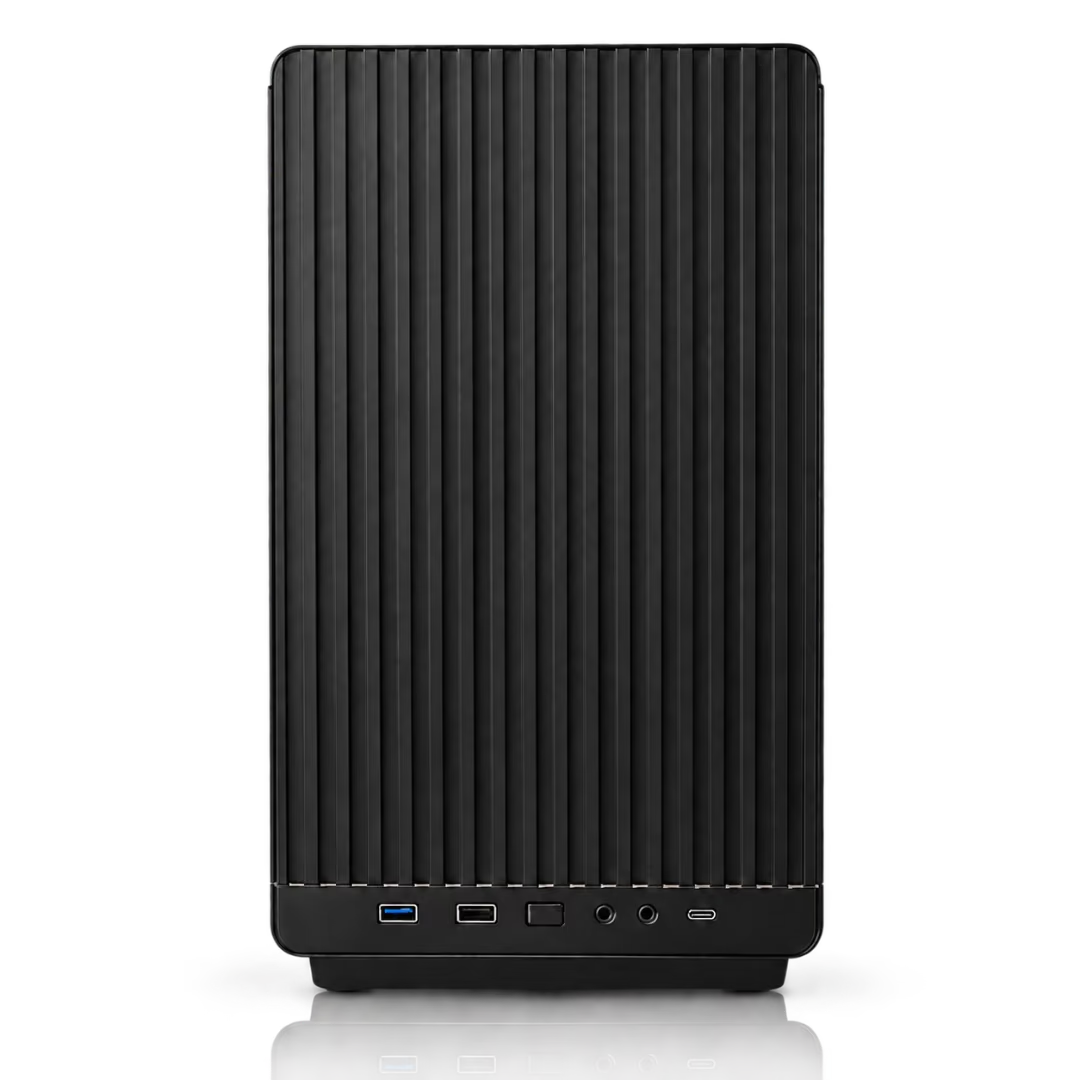
Locai Labs builds Locai One, an on-prem AI appliance. It is one machine that arrives with everything already in it: the hardware, our open-weight Locai Juno models, and Locai OS, the operating system that serves the models and handles users, access and monitoring. You plug it into a mains socket and your network, and your team is working in about 15 minutes. No cloud account, no per-token bill, and nothing leaving the building.
The reason a data-centre-class model fits in a box on your floor is SPACE, our compression algorithm. Instead of asking how much of a model can be cut while keeping it broadly similar, SPACE asks what the model needs to be good at, preserves the subnetworks behind those capabilities and strips back the rest. The result is a smaller specialist rather than a shrunken generalist, tuned to the exact hardware it ships on.
Locai One starts at £29,950 for a team, and Locai One Pro at £49,950 for an organisation, bought once and owned outright. Both run air-cooled on standard mains power and work fully air-gapped. Any compatible open-weight model runs alongside Juno, and if you need a model trained on your own proprietary data we can post-train one and deploy it on the same machine.
Frequently asked questions
Can I keep Azure and still own my model?
Yes. Locai models can run inside your Azure tenant, so you keep your cloud and residency posture while gaining model ownership on top.
Isn't Azure OpenAI already compliant enough?
It can satisfy many requirements, but compliance controls don't give you the weights, domain specialisation, or freedom from deprecation. Those need model-layer sovereignty.
What's the practical difference day to day?
With Azure OpenAI you call a general model you rent; with Locai you run a domain-expert model you own that improves on your data over time.
Book a sovereign AI briefing
A 30-minute session on owning your model: deployment options, the data path, and a clear cost range for your use case.