Explainer
What does owning your AI model mean?
The difference between holding an asset and holding an API key, and what real model ownership buys a regulated enterprise.
By James Drayson
In short
Owning your AI model means holding the model weights, the training data, and the intellectual property outright, the asset itself, not a licence to call someone else's model or an API key that can be revoked.

What ownership actually buys you
- Hold the weights and IP: The model artefacts and post-training pipeline are yours. You can run, inspect, move, and build on them without anyone's permission.
- A full audit trail: Because you hold the weights and training data, you can answer regulators and auditors about exactly what the model learned and why.
- No forced deprecation: No vendor can switch off, rate-limit, or silently change the model your business depends on.
- An asset that compounds: With continual learning via Forget-Me-Not, the model keeps learning from your team's work, so it appreciates over time instead of depreciating.
Licence vs ownership
Most enterprise AI is licensed access: you pay to query a frozen model that belongs to someone else, and your investment buys usage, not the asset. When the contract ends, you keep nothing.
Ownership means the opposite. The model is on your balance sheet as a capability you control, trained on knowledge no competitor has, and it stays with you regardless of any vendor relationship.
Ownership in practice
Your data, your moat
A model trained on your proprietary knowledge is a durable advantage competitors cannot copy from a public API.
Deploy anywhere
Because you own the weights, you choose where it runs, on-prem, air-gapped, your cloud, or a sovereign cloud.
Retain all outputs
No third party holds rights to your model's outputs, weights, or training data.
Compounding value
Scheduled retraining keeps the model current with your domain instead of stale after launch.
What this looks like with Locai
Sovereignty stops being a contractual promise when the machine is standing in your own building. Here is what that looks like in practice.
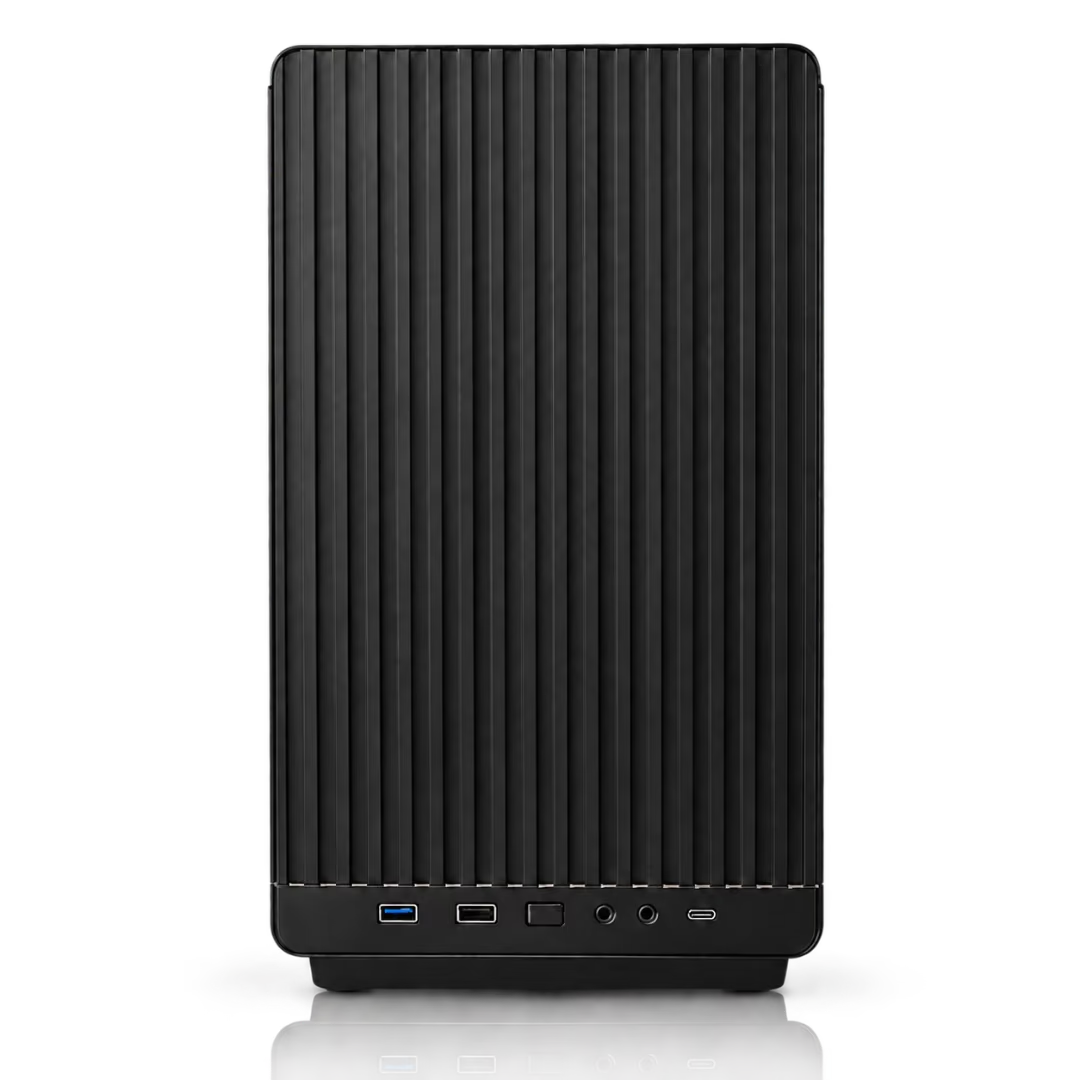
Locai Labs builds Locai One, an on-prem AI appliance. It is one machine that arrives with everything already in it: the hardware, our open-weight Locai Juno models, and Locai OS, the operating system that serves the models and handles users, access and monitoring. You plug it into a mains socket and your network, and your team is working in about 15 minutes. No cloud account, no per-token bill, and nothing leaving the building.
The reason a data-centre-class model fits in a box on your floor is SPACE, our compression algorithm. Instead of asking how much of a model can be cut while keeping it broadly similar, SPACE asks what the model needs to be good at, preserves the subnetworks behind those capabilities and strips back the rest. The result is a smaller specialist rather than a shrunken generalist, tuned to the exact hardware it ships on.
Locai One starts at £29,950 for a team, and Locai One Pro at £49,950 for an organisation, bought once and owned outright. Both run air-cooled on standard mains power and work fully air-gapped. Any compatible open-weight model runs alongside Juno, and if you need a model trained on your own proprietary data we can post-train one and deploy it on the same machine.
Frequently asked questions
If I fine-tune a model on an API, do I own it?
Usually not. Fine-tuning on a hosted API typically produces an adapter that lives on the vendor's platform under their terms, you still can't export the base weights or run it independently. True ownership means holding the weights yourself.
Does owning the model mean I'm responsible for running it?
You can run it yourself, or have Locai operate it for you (including in Locai's UK sovereign cloud) while you retain ownership of the weights and IP.
What is Forget-Me-Not?
Forget-Me-Not is Locai's post-training framework that adapts a base model to your domain while preserving its general capabilities, mitigating catastrophic forgetting, so an owned model can keep learning continually without degrading.
Book a sovereign AI briefing
A 30-minute session on owning your model: deployment options, the data path, and a clear cost range for your use case.